Lab Automation System for Simulating Martian Environment -
Date
Sept 2024
Service
Client
Department of Botony, SJC, Trichy.
Project Overview
Intelligent Lab Automation System for Simulating Martian Environment in Plant Growth Chambers
Youtube link:
Problem Statement
Controlled environment agriculture is essential for plant growth research, especially when studying extreme environments such as Martian-like conditions. Traditionally, such experiments involve manual image capturing, environment monitoring, and light regulation, which are time-consuming, error-prone, and labor-intensive. Moreover, the need for continuous data collection and environmental control over extended periods adds complexity and operational overhead to such experiments.
Project Objective
The goal of this project was to design and implement a fully automated laboratory plant growth chamber that simulates a Martian atmosphere. The system was built to support long-term plant experiments by automating key environmental and observational tasks. The main objective was to reduce manual intervention, improve data accuracy, and ensure consistency across growth cycles through a smart integration of hardware and software systems.
Project Components and Architecture
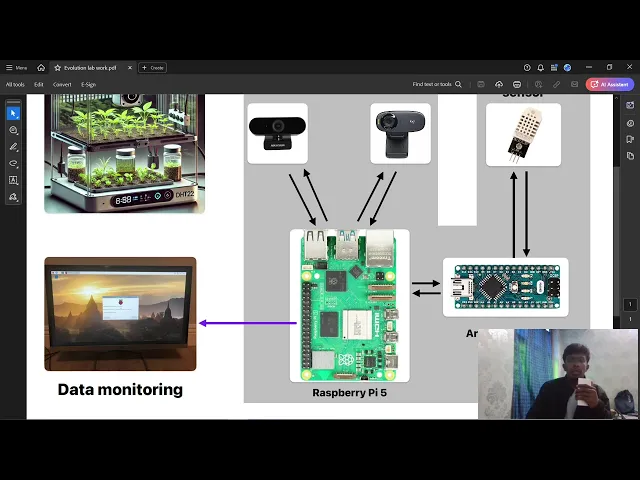
The system was developed using a combination of Raspberry Pi 5, Arduino Uno and Nano, and various sensors and actuators. The key hardware and software components included:
Hardware Used
Raspberry Pi 5 – Central controller and data logger
Arduino Uno – Relay-based automation for lighting control
Arduino Nano – Interface for DHT22 sensor data collection
DHT22 Sensor – Temperature and humidity sensor
Logitech C270 Webcam – High-definition image capture
Hikvision Webcam – Secondary webcam for monitoring
Relay Module – Control for LED lighting
Two LED Tube Lights – Artificial light source for plant photosynthesis
Software Stack
Python – Data logging and automation scripts on Raspberry Pi
Excel (via
openpyxlorpandas) – Structured environmental data storagefswebcam – Image capture utility for Logitech webcam
Custom Bash Scripts / Cron Jobs – Scheduled automation
Arduino IDE – Programming control logic for Uno and Nano
System Features and Automation Workflows
1. Automated Image Capture
Both Logitech C270 and Hikvision webcams were configured to capture images every 2 hours.
Images were stored in timestamped folders, uniquely named to differentiate sessions and dates.
Frame rate tuning (35 FPS) was performed on the Logitech C270 to overcome black image capture issues.
2. Environmental Data Logging
The DHT22 sensor, interfaced with Arduino Nano, captured temperature and humidity data every 15 minutes.
Data was transferred to Raspberry Pi and logged in a structured Excel (.xlsx) format, facilitating analysis over time.
3. Automated Lighting Control
A 12-hour light ON/OFF cycle was implemented using Arduino Uno and a relay module.
This replicated Earth-like photoperiods within the chamber to study plant behavior under controlled Martian conditions.
Challenges and Solutions
Webcam Compatibility: The Logitech and Hikvision webcams differed in firmware and driver behavior. Custom configurations and frame rate adjustments resolved image clarity and capture failures.
Timing Accuracy: Reliable cron job scheduling and hardware-software synchronization ensured precise intervals for both logging and imaging tasks.
File Management: Implemented automatic directory creation and file naming conventions to prevent overwriting and facilitate data traceability.
Project Outcomes and Impact
Achieved fully automated monitoring and control of environmental and lighting parameters for extended-duration plant studies.
Enabled consistent and repeatable data collection without manual intervention, ideal for biological and agricultural research.
Created a scalable system design that can be adapted to simulate other planetary environments.
Enhanced research quality while significantly reducing human effort and risk of error.
Technologies and Skills Demonstrated
Embedded Systems: Arduino Uno & Nano interfacing, sensor data handling
IoT Integration: Hardware-software communication using Raspberry Pi
Automation Scripting: Cron jobs, Python-based task automation
Computer Vision Readiness: Image capture and storage for later analysis
Data Management: Structured environmental data logging in Excel
Troubleshooting and Optimization: Hardware calibration, frame rate tuning, multi-device integration
Applications and Future Scope
This project has direct implications for:
Controlled environment agriculture (CEA)
Astrobiology and space-based plant research
Smart greenhouses and vertical farming systems
Automated laboratories in educational institutions
Future enhancements may include:
Real-time dashboard for remote monitoring
Integration with cloud platforms for global data access
Automated image analysis using machine learning to assess plant health